 UmojaPride
Stories, Feature
Bishop Christopher Senyonjo, 1931–2026: The Bishop Who Loved His Neighbour
Uganda's Bishop Christopher Senyonjo stood with LGBTQ+ people when his church turned against him. A tribute, and why he reminded me of my grandfather.
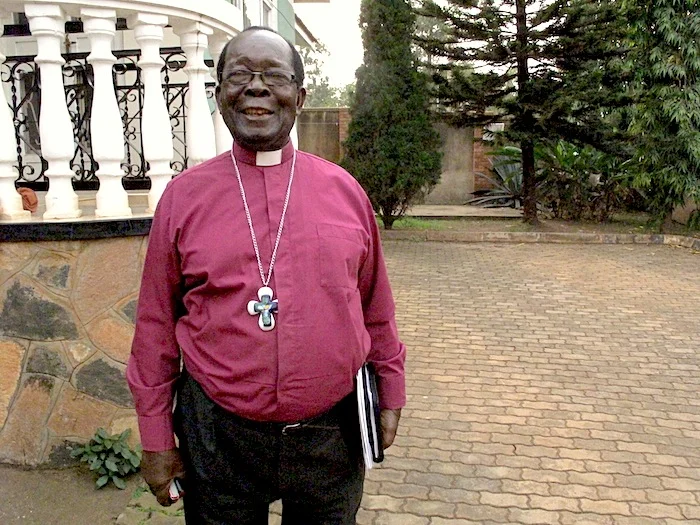
Bishop Christopher Senyonjo died in Kampala on 19 July 2026, aged 94, after nearly two months in hospital. In his last weeks, Sexual Minorities Uganda asked the public for prayers and for help with his medical costs. Three months on, I want to set down why his life mattered, to Uganda’s LGBTQ+ community and to me.
Why he matters to me
I come from an Anglican family. My grandfather was a reverend, and he died in 1997, when I was very young. I only have a handful of memories of him, but one has stayed with me more clearly than the rest: the steady stream of visitors to our home. People came to him all the time, and he made room for every one of them. He was a man of the cloth, and he could have kept people at a distance. He never did. No one was turned away. I did not understand it then, but I grew up carrying that lesson with me: you care for people, whoever they are. When I look at Bishop Senyonjo, I see my grandfather in him.
What stood out to me was not only that he was a churchman, but that he stood for the truth about LGBTQ+ people when almost no one else in his position would. Many religious leaders in Uganda preach “love your neighbour” on Sunday and fuel hatred and division for the rest of the week. Bishop Senyonjo refused to live with that contradiction. He showed that a Ugandan Anglican bishop could hold to his faith and still defend the people his church condemned.
A life in the church
He was born on 8 December 1931 and grew up in what is now Kiboga district. He studied at King’s College Budo and Makerere, trained for ministry at Buwalasi Theological College, and continued his studies at Union Theological Seminary in New York, where he was ordained a priest in 1964.
Back in Uganda, he taught African traditional religion at a theological college from 1968, and worked on the 1973 translation of the Bible into modern Luganda alongside Catholic, Seventh-day Adventist and Anglican colleagues. In 1974 he became Bishop of West Buganda, and he served until he retired in 1998.
The counsellor who listened
After retiring, he ran a small counselling practice near Kampala. Gay Ugandans began to seek him out. Kuchu Times recalls that he counselled a young gay man who had been thinking about ending his life, and told him that God loved him as he was. In 2000, he took in two young LGBTQ+ people who had been rejected by their families, schools and communities.
He went on to found Integrity Uganda and the St Paul’s Reconciliation and Equality Centre in Kampala, a place where LGBTQ+ people could find counselling, support and a welcome.
“The attitude of my church is that I should condemn them. But I refuse.”
Bishop Christopher Senyonjo, as quoted by Kuchu Times
What it cost him
The Church of Uganda restricted his ministry from 2002, stopped his pension, and in 2006 declared that he was “no longer a bishop”. The church said the dispute was about his involvement with a church outside its communion. Many people, in Uganda and abroad, understood it to be about his support for LGBTQ+ people.
He did not accept that he had stopped being a bishop. “You are consecrated for life,” he said, “so logically, you remain a bishop.” He did not start a church of his own. He said he wanted to keep talking with his fellow bishops instead.
In 2014, the Red Pepper tabloid put him on a list of Uganda’s “200 top homos”, alongside Frank Mugisha. He criticised both the 2014 and the 2023 Anti-Homosexuality Acts as inhumane and contrary to the Universal Declaration of Human Rights. We have written about the human cost of the 2023 Act.
Asked about it later, he said: “It has cost me quite a lot, but I do not regret doing this work.”
Recognised abroad
Outside Uganda, his courage was honoured. In 2012 he received the Clinton Global Citizen Award for his work through the St Paul’s centre. In 2018 the University of Leeds awarded him an honorary Doctor of Laws, describing him as “one of the few religious leaders in Uganda, and indeed in Africa, who actively supports LGBT” people. He appeared in the documentaries Call Me Kuchu (2012) and God Loves Uganda (2013), and set out his theology in his book In Defense of All God’s Children.
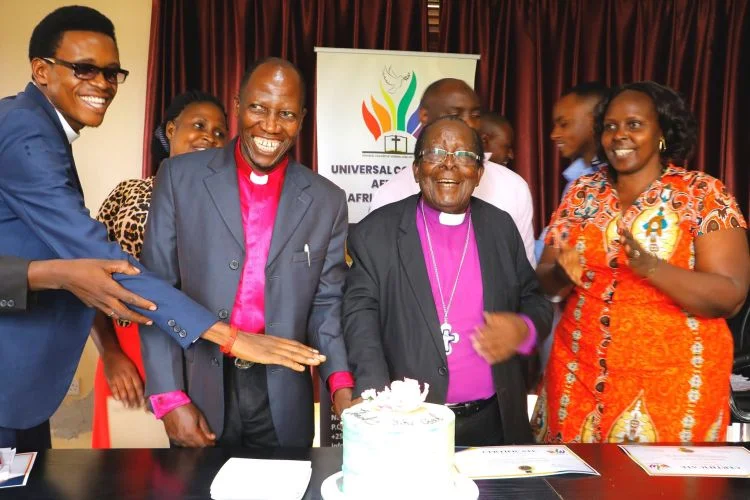
Even in his nineties, he was still taking part, including at a 2023 event hosted by the Universal Coalition of Affirming Africans in Uganda.
Love your neighbour, without exceptions
“Love your neighbour as yourself” is not a footnote in the Christian faith. It is, in the Gospels, one of the two greatest commandments. Yet in Uganda it is often church leaders who stand at the front of campaigns against LGBTQ+ people, repeating claims the evidence does not support.
Bishop Senyonjo’s answer was simple. “I am doing something which I believe God has told me to do,” he said. “Love all people.” He believed that people do not need to change their sexuality to be loved by God, and he lived as though he meant it.
For Ugandan families who are torn between their faith and their LGBTQ+ children, his life is proof that there is no need to choose. A Ugandan bishop, raised in the same churches many of us were raised in, looked at the people his church condemned and saw neighbours.
What he leaves behind
Frank Mugisha of Sexual Minorities Uganda called him a “fearless ally”. Richard Lusimbo of the Uganda Key Populations Consortium said his life showed that justice demands courage and compassion. Professor Adriaan van Klinken of the University of Leeds wrote that his spirit “will indeed live on in the many people he inspired, in Uganda and globally”.
I think of my grandfather, and of Bishop Senyonjo, and of what it means to serve as a minister. For me, Bishop Senyonjo showed what that calling looks like at its best: standing beside the people others push away, whatever it costs.
Rest in peace, Bishop. Thank you for refusing.