 UmojaPride
© 2026 UmojaPride. All rights reserved.
Aug 09, 2026 12:35:08 PM
Nobody Filmed This for Free: Uganda's Outing Videos
There is a video I will not describe in detail, and I will not link to it. You may already have seen it. If you are Ugandan and you have opened TikTok in the past month, the feed will almost certainly put it in front of you whether you looked for it or not.
In it, a well-known TikTok personality who goes by the alias Sinful Bae a young person who presents and lives publicly as a woman, is surrounded, publicly outed, and has her hair cut off. She is told to dress as a man. To "fit". The people who did this said she had been obtaining money by pretending to be a woman. That accusation has not been tested anywhere, by anyone. No charge, no evidence, no court. It circulated because it was useful, it gave the humiliation a story, and the story gave people permission to watch.
Then came what always comes next. Within days, others were being filmed. A friend of mine who I will not name here, and those who know him will understand why, was recorded, shamed and beaten. The footage was uploaded the same day, because uploading it was the point. It went viral too.
 TikTok has been used by many people to cash in on humiliating others
I should say plainly where I stand. I am a straight, married Ugandan man, and an ally for the LGBTQ+ community. That last bit places me on the radar of the feed attack. I am writing about this because my friend is not a hypothetical to me, and because the people producing this content are not foreigners. They are us. That is the part I think we have not been honest about.
The details of these incidents come from the community, victims and from the footage itself; much of it has not been independently reported by any newsroom, and some of it may never be. That is part of the problem. But the pattern is not in dispute by anyone living in Uganda.
The feed did not invent this hatred. It set a price on it.
Uganda did not need a recommendation engine to learn contempt for queer people. We had our legislators decide almost unanimously on the Anti-Homosexuality Act of 2023 with its life sentences and its "promotion" offence that makes advocacy itself a crime. We had the pastors, the newspapers that printed names and addresses, the neighbours. The hostility was already fully formed.
What is new is the economics.
Outing someone used to cost you something. You risked being seen as a snitch, someone with too much time. The social ledger did not obviously reward you. Now it does. A phone, a crowd, thirty seconds of someone's worst moment, and the platform hands you an audience larger than any you have ever had. Followers. Comments. Gifts, sometimes actual money. The algorithm does not hate anyone. It is indifferent, and it has noticed that this particular humiliation performs.
That is what "engagement optimisation" means in a country where being gay is criminalised. The system is designed to find whatever holds attention and give people more of it. Attention is not the same as approval. Rage holds attention. Disgust holds attention. A crowd around a frightened person holds attention very well indeed. The machine measures the watching and concludes, correctly, that it has found something people want. It cannot tell the difference between interest and cruelty, and it was never built to.
So the incentive runs one way. Make the video. Watch the numbers. And the next person watching learns the lesson: shortcut to stardom.
What it does to the people on the other end of it
I can only report what I am told, and what I have watched happen to someone I care about.
The risk is no longer bounded by geography. Being seen by the wrong person at a boda boda (motorcycle taxi) stage used to be a local danger. Now one clip reaches your mother's village, your employer, your landlord, your church, in a single afternoon.
The archive is permanent. Videos are downloaded, reposted, stitched, reacted to. Even when a platform removes the original, multiple copies survive with new captions. You cannot be un-outed.
The self-policing is now heavier than anything the state could impose. People are deleting accounts that were their only community. Changing how they dress on ordinary Tuesdays. Declining to visit friends. Not going to the clinic, because the clinic is where people like them are known to go, and someone might be filming outside. The chilling effect of the law was severe. The chilling effect of the feed is closer to total, because the feed is everywhere and it never closes.
And grief has nowhere to go. When a person is attacked, the footage becomes content their friends must scroll past, repeatedly, for weeks. There is no dignity in it and no end to it.
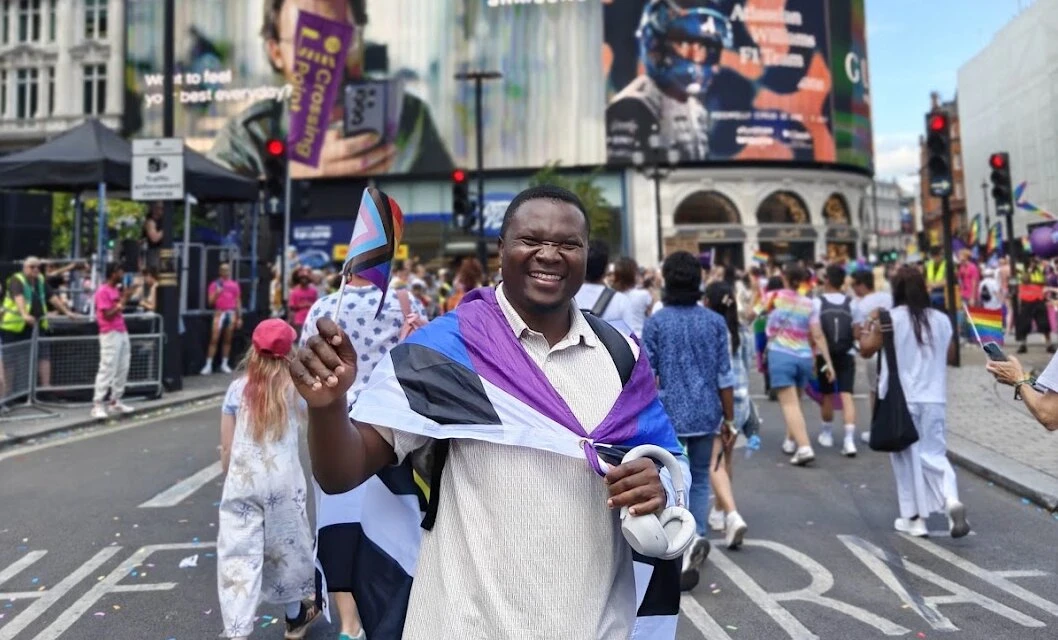
UmojaPride founder and LGBTQ+ ally at a recent Pride event in London, United Kingdom
Three things need to change, and they are not equally hard
- The platforms have to enforce what they already claim. Every major platform's rules already prohibit outing a person's sexual orientation or gender identity without consent, and prohibit content showing an assault for entertainment. These policies exist. They are simply not enforced here at the speed the harm requires. The reasons are not mysterious: too little moderation capacity in Luganda and other local languages, over-reliance on automated systems trained on other contexts, and appeals that take days when the damage takes hours. There is also a specific ask, and it is not vague. Content that outs a person should not be eligible for monetisation, for gifting, or for recommendation into anyone's For You page. If the incentive is money and reach, remove the money and the reach.
- The rest of us have to stop pretending that watching is neutral. This is the harder one, because it implicates far more people than the ones swinging fists. If you did not film it, did not repost it, did not comment — but you watched, and you let it play to the end — you are part of the reason it was made. That is not a moral flourish, it is a technical fact about how the system works. Every second of your attention was counted, and the count is what tells the platform to show it to the next hundred thousand people. The mob in the video is small. The mob that makes the video worth making is enormous, and most of it thinks of itself as uninvolved. If a clip like this reaches you: do not watch it through, do not quote-post it to condemn it, do not screenshot it. Report it and scroll on. Outrage-sharing is still sharing.
- And for those actually at risk: practical steps, and please do not be alone in this. Lock down what you can — private accounts, tightened friend lists, two-factor authentication, old photographs removed. Assume anything shared in a group chat can leave it. Agree with two or three trusted people on what happens if one of you is exposed: who is called, where you go, who holds a spare key. If you are filmed, save whatever evidence you can and get it to an organisation that documents these cases, because documentation is how patterns eventually become undeniable to people who currently look away.
I am aware that none of this amounts to protection, and it is not my place to pretend otherwise. But isolation is exactly what this pattern produces, and refusing it is one of the few things still fully in reach.
What is actually being asked for
Not sympathy. Sympathy has been abundant and useless.
It is that the systems distributing this material stop treating people's safety as a rounding error in an engagement metric and that those of us who consume it stop telling ourselves that consumption is innocent.
The young woman whose hair was cut off did not lose it to a mob alone. She lost it to a mob that knew the footage would travel, and to everyone who made sure it did.
UmojaPride.org documents and reports incidents of violence and online harassment against LGBTQ+ people in Uganda. If you have been targeted, or you have footage or accounts that can help us document a case, contact us. We do not publish identifying details without consent.